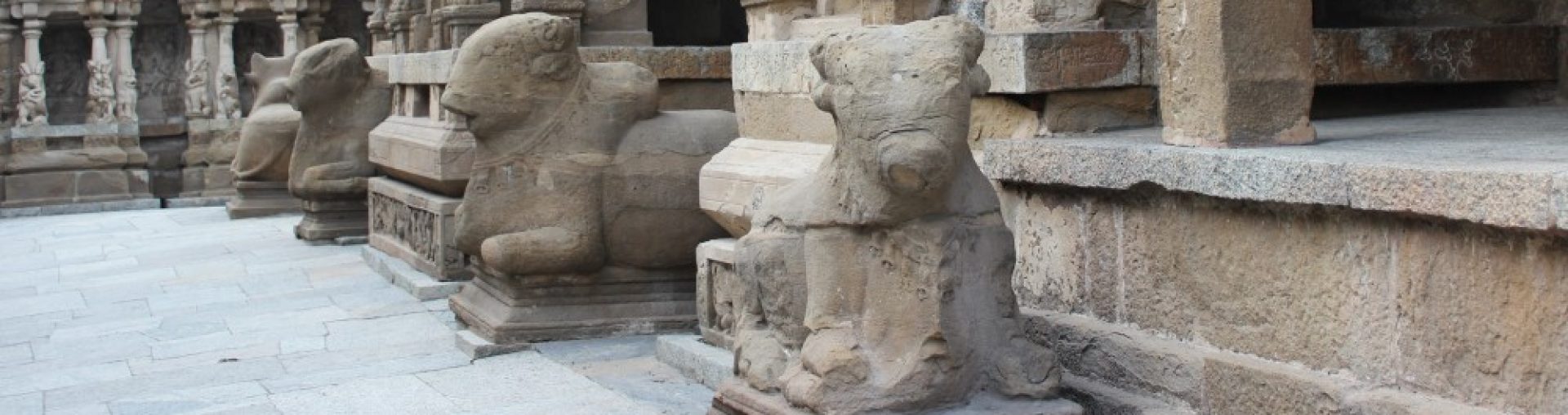

Saivism, the word derived from its principal deity Shiva hails Him as the omnipresent and
omnipotent of all Gods. He mystically reveals Himself in the form of five essential elements
of nature in five temples namely, Ekambareswarar temple, Kanchipuram (earth),
Jambukeswarar temple, Thiruvanaikka (water), Arunachaleswarar temple, Thiruvannamalai
(fire), Kalatheeswarar temple, Kalahasti (air) and Vadaranyeswarar temple, Thiruvalangadu
(cosmos). As the ecstatic Lord of Dance, He dances in five divine Dance Halls namely, the
Golden Hall (Chidambaram), Silver Hall (Madurai), Copper Hall (Tirunelveli), the Hall of
Gems (Thiruvalangadu) and the Hall of Murals (Kutralam).
It is indeed interesting and intriguing to note that all these sacred abodes fall inside
Tamilagam (Kalahasti was part of Tamilnadu till States Reorganisation Act, 1956), though
Shiva is worshipped across India. Among the temples, Thiruvalangadu gets the unique
importance of claiming a place in both the above mentioned categories.
The word ‘Thiruvalangaadu’ is a compound of three words – thiru (prefix for reverence), aal
(banyan tree) and kaadu (forest). The present day name of the God- ‘Aranyeswarar’ is a
sanskrit translation of the original tamil name, a solid case of continued conscious effort to
sanskritize ethnic religious names/beliefs.
Apart from being one of the five most sacred sites as well as one of five important Dance
Halls of Shiva, Thiruvalangadu is also the first temple of the Tamil Bhakti movement to
provide literary evidence on the Dance of Shiva, as witnessed by His demon devotee
Karaikkal Ammaiyar, prior to Appar and Sambandhar.
Tandavam denotes the high spirited masculine form of dance full of vigour, in contrast to
Lasyam the gentle feminine dance, full of elegance and grace. He revealed in Thillai
(Chidambaram), His blissful euphoric Dance of Ananda Tandavam, from which the Chola
sculptors captured in stone the ecstatic pose of Adavallan/ Nataraja, the Cosmic Dancer.
Though the purpose of Shiva’s Thandavam differs in His five divine dance halls, the iconic
pose chosen to represent His electrifying performances in four places was that of Ananda
Tandavam. But in Thiruvalangaadu, His performance was filled with stormy steps and fierce
strides, as per literary clues given by Ammai, in the 4th- 5th centuries CE. Scholars
categorise this as Urdhva Tandavam or Kali Tandavam- Urdhva Tandavam as the dancer’s
leg is raised upwards towards the skies and Kali Tandavam as it was performed to win Kali
in a dance competition and emerge as the unbeatable Dancer.
The main reason, Thiruvalangadu is revered as the victorious destination of Shiva’s
unconquerable dance skills is Karaikkal Ammai’s poetry. Consequently, the stunningly
distinct iconographic representation of Dancing Shiva in Thiruvalangadu is also undoubtedly
due to Ammai’s hymns. The competition between Shiva and Kali and how Shiva emerges
victorious with the lift of His leg is subtly mentioned by Ammai (வாதித்து வீசி எடுத்த
பாதம் / He throws his leg upwards following an argument or feud) in her Mootha
Thiruppathigam.
Additionally, in Arputha Thiruvandhaathi, Karaikkal Ammai asks the Lord to be cautious while performing his aggressive Dance, that can be related with the fierce Urdhva Tandavam-
அடிபேரிற் பாதாளம் பேரும் அடிகள்
முடிபேரின் மாமமுகடு பேரும்- கடகம்
மறிந்தாடு கைபேரின் வான்திசைகள் பேரும்
அறிந்தாடும் ஆற்றாது அரங்கு
(arputha thiruvandhaathi stanza 77)
- When you bang your feet on the floor the nether world shatters
- When you raise high, your Head smashes the clouds
- When your arms that are adorned with bracelet move, the directions scatter
- The World cannot survive, O Lord, Dance with Care
Here, a couple of questions arise.
a. Why Karaikkal Ammai’s verses need special focus in the field of Dance, which considers
Shiva as the Supreme Dancer? And, b. How do we know the dance field of Kali – the graveyard became the wandering gentleman’s intensely spirited stage?
By portraying the Dance of Shiva in the graveyard, she was the pioneer saiva saint to have emphasised and vociferously professed in Tamilagam, that Shiva was the Supreme Dancer. This was much before the glorifying titles- ‘koothadavallaan’, ‘adavallaan’ (first time in inscriptions) and ‘nataraja’, He received from Appar, Uthama Chola and Nayakas respectively.
Ammai mentions in three places in her Mootha Thiruppathigam that the stage had always belonged to Kali, the Goddess of Dance and Shiva presently dances in the forest of Thiruvalangadu, where Anangu used to Dance.

urdhvar in (top right) kailasanathar, (left) airavatheswaram, (below right)
mathangeswaram
A few centuries later to Ammai, the Pallavas were the first to create Shiva in Urdhva form in
the sculptures of Tamil temples. Temples of Kailasanathar, Airavatheswaram and
Mathangeswaram in Kanchipuram stand testimony to this. The Sanskrit word ‘Urdhva’ means raising or lifting upwards. Hence, the sculptures of Urdhvar show the lift of the leg
towards the sky.
Practically, in order to pose for the Urdhva shot, the artist needs his/her right hand to encircle
the fully lifted right leg for balance. Likewise, in Shiva’s Urdhvar sculptures, one of His right
hands can be seen around the lifted right leg in abhaya pose. The left leg is either straight in
samam as in Airavatheswaram or bent in mandala sthana as in Mathangeswaram,
Kanchipuram.
The closest karana to this Urdhva pose is Lalatatilakam. Lalatatilakam involves the leg
movement of the vrischika karana, where the leg is bent and turned towards the back and
lifted upwards to make a mark on the forehead with the great toe.
But, is this sculptural illustration of Urdhvar as connected with karana lalatathilakam similar
to the description of Karaikkal Ammai? Doesn’t seem so.
Ammai’s verses –
மண்டலம் நின்றங் குளாளம்இட்டு வாதித்து வீசி எடுத்தபாதம்
அண்டம் உறநிமிர்ந்தாடும் எங்கள் அப்பன் இடந்திரு ஆலங்காடே
(mootha thiruppathigam stanza 4)
-specifically show ‘veesi edutha paatham’- the throw of the leg as the captivating move that
caught her eyes. The next phrase ‘andamura nimirndhaadum’ can also be interpreted as one
among the several subsequent actions of the entranced dancer apart from or after the throw
of the leg – stretching further upward to reach the skies, as in sculptures of pallava urdhvar.
Furthermore, the throw of the leg that enthralled Ammai in the first place has been aptly
comprehended by the sculptor in Thiruvalangadu. Thus, the sculpture of Dancing Shiva in
Thiruvalangaadu is a perfect representation of Amma’s ‘veesi edutha paatham’, that is
thrown upwards. It seems to be a controlled propel and not a leisure lift.

ammai’s adavallaan, thiruvalangadu
Picture Courtesy- DEB’s WORLD
In that case, among the 108 karanas of Shiva that Thandu taught Bharata and his disciples,
which one is closest to what Karaikkal Ammaiyar portrays in her hymn, that the sculptors
chose as the Thiruvalangadu shot? This would be correlated with the karana sculptures of
Sarngapani temple, Kumbakonam.
Descriptions of a few karanas as per Bharata’s verses seem to resemble the move Ammai specifies- ‘veesi edutha paatham andamura nimirndhaadum’, namely-
- Dandakarecitam (karana 41), where hands and feet are thrown on all sides like a danda/staff and the hands in recita;
- Talasamsphotitam (karana 69), where the foot is swiftly lifted up and put forward
- Dandapadam (karana 82), where the leg is stretched like a staff after nupurapadika chari.
- Vishnukrantham (karana 100), where, a foot is to be stretched forward as kunchitha/ with
a bend, and raised towards the sky with recita hands.
The closest among the four would be Dandapadam and Vishnukrantam. But, Nupurapadika
chari that involves the gentle twist of the hip, makes Dandapada karana more of a gentle and gracious move, rather than a fierceful throw of the feet, that is the main feature of Shiva’s ‘veesi edutha paatham’.

karana sculptures in sarngapani temple, kumbakonam
Of course, the dance of Shiva that Ammai watched would have had all the twists, twirls and
throws that can also be featured in the above mentioned karanas. However, Bharata’s words
on Vishnukrantha (karana 100) provides a clearer insight. Ammai states that Shiva stood in
mandala position, threw His leg upwards and danced to victory with His leg reaching the
skies. In Vishnukrantam too, the stretched leg is further raised towards the sky. The
definition of Vishnukrantam in Natya Sastra gives the vision of a completed action, as per
the spectator.
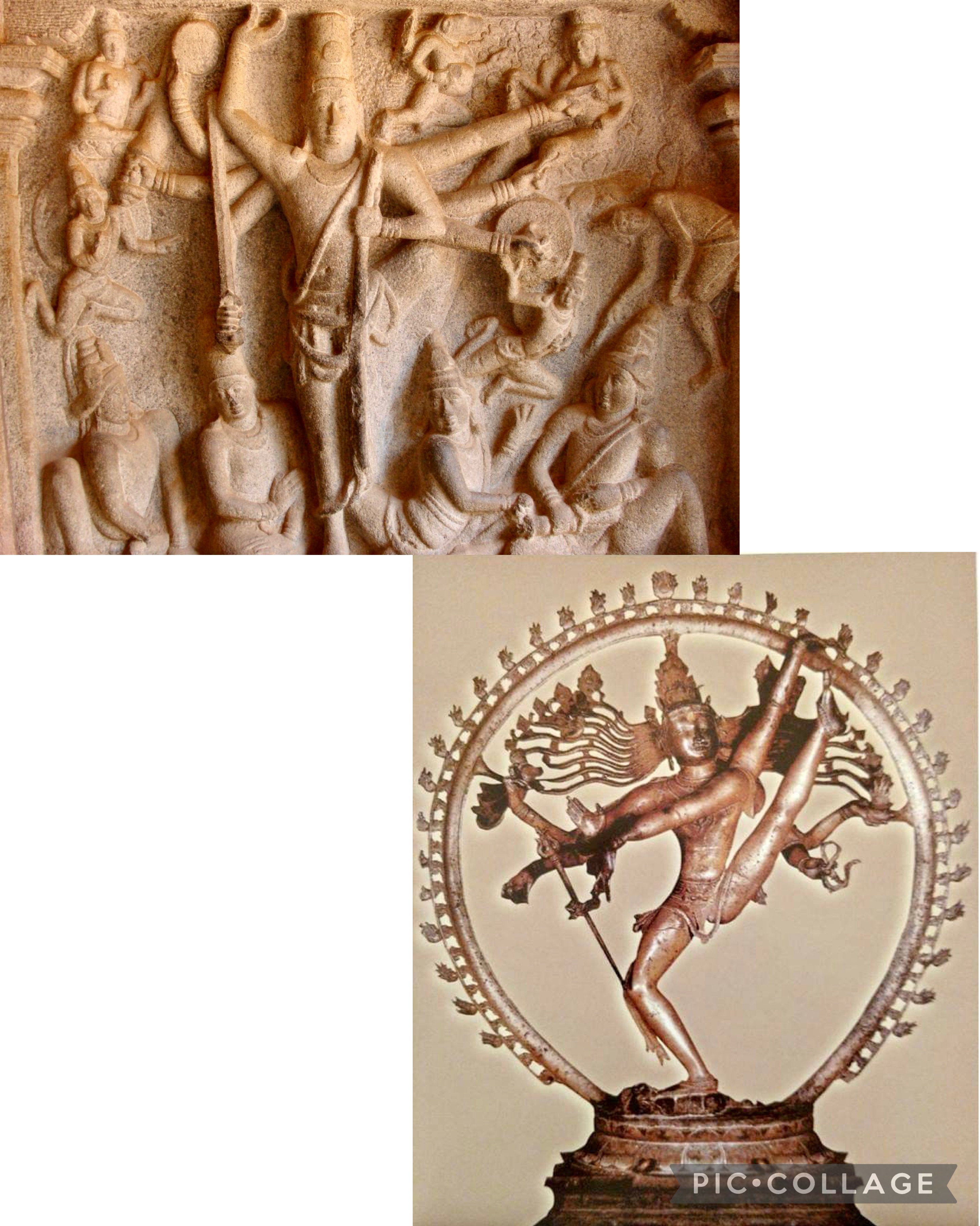
trivikrama, mamallapuram and the supreme dancer, thiruvalangadu
- Courtesy- Trivikrama, mamallapuram- George Keith
- Thiruvalangadu, DEB’S WORLD
Hence, it can be said that the Thiruvalangadu sculpture exemplifies karana Vishnukranta.
The 100th karana as per the Natya Sastra, Vishnukranta gets its name from Vishnu. It
literally translates as the step of Vishnu. Vamana or the dwarf holy man is one of the ten
incarnations of Vishnu in Vaishnavite mythology. Upon King Mahabali granting alms to
Vamana, the dwarf holy man assumes the form of Trivikrama acquiring Mahabali’s kingdom
besides taking control over the three worlds with His three strides.
V. Gopinatha Rao in his ‘Elements of Hindu Iconography’ (Volume 1 part 1) explains – “The
image of Trivikrama may be sculptured, it is said, in three different ways, namely, with the left
foot raised up to the level of (1) the right knee, or (2) to the navel, or (3) the forehead. These
three varieties are obviously intended to represent Trivikrama as striding over the earth,
mid-world and the heaven-world respectively”.
This step of Vishnu that symbolises His victory over the three worlds, (specifically the raised
foot towards the forehead to conquer the heavens) is called Vishnukranta, adapted as one of
the 108 karanas in Bharata’s Tandavalakshana. It is absolutely a surprising co-incidence that
two different mythological events connected with two different Gods are illustrated and
identified with one similar posture and specifically with similar movements of leg and foot.
More astoundingly, both steps have been used to declare triumph, one- of the territory that
belonged to King Mahabali and the other- of the dance field that belonged to Goddess Kali.
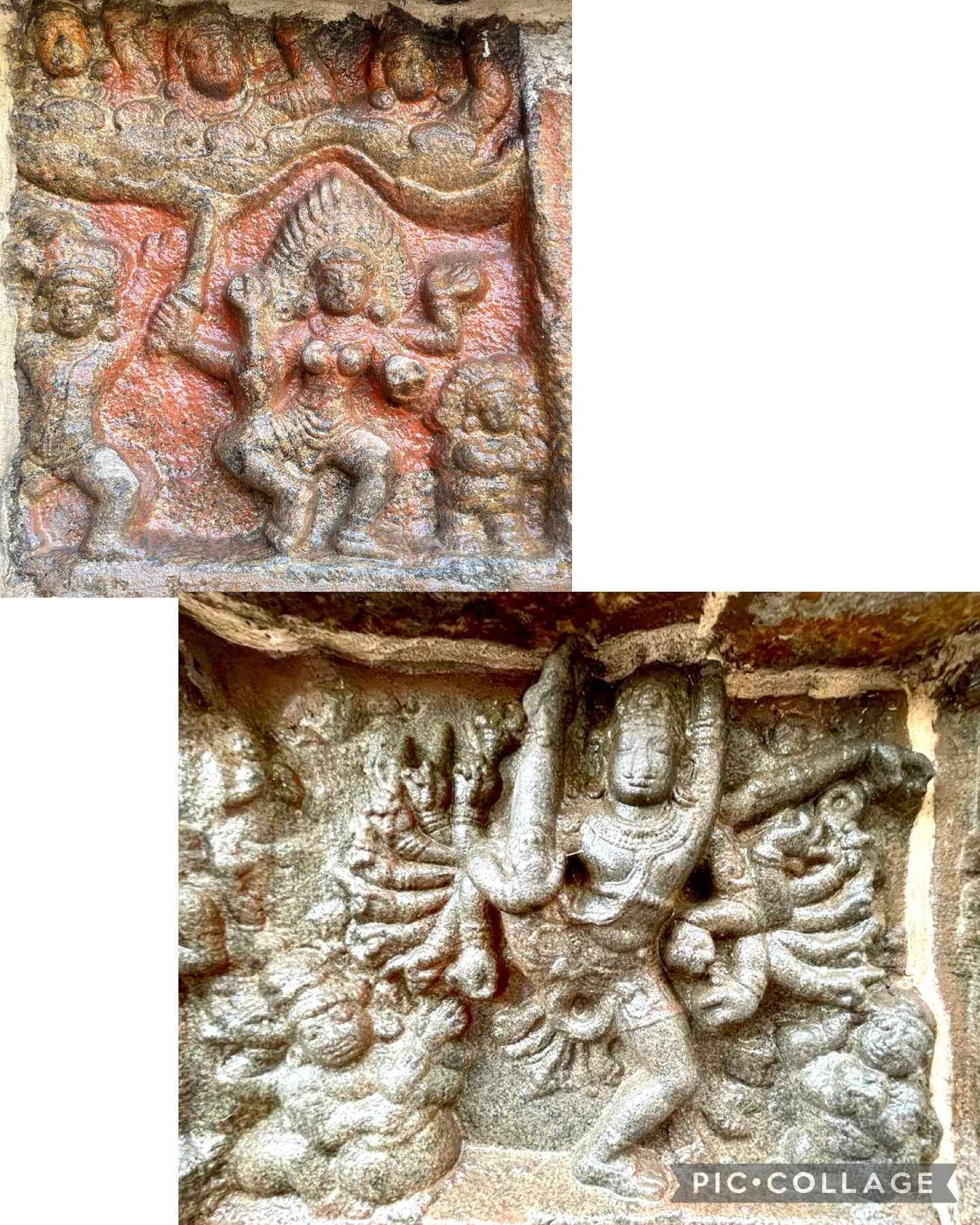
kali and urdhvar, sarangapani temple, kumbakonam
Noted in sangam literature, the story of Vishnu’s victory precedes the victory of Shiva as per
tamil literary evidences. In the 3rd poem of Paripadal (“திணி நிலம் கடந்தக்கால் திரிந்து அயர்ந்து அகன்று ஓடி, நின் அஞ்சிக் கடற்பாய்ந்த பிணி நெகிழ்பு அவிழ் அவிழ் தண் தார் அன்னவர் பட, அல்லா அவுணர்க்கும் முதல்வன் நீ” 3/54-56), poet Kaduvan Ilaveyinanar exclaims the greatness of Thirumal and praises Him as the Lord of not only the Amarar (celestials), but also the Asurar
(demons) who feared and jumped into the ocean, while He measured the firm land.
Also in Kalithogai (“ஞாலம் மூன்று அடித்தாய முதல்வற்கு முதுமுறைப் பால் அன்ன மேனியான்”- neithal kali, 124), poet Nallanthuvanar mentions Balaraman as the elder brother of Thirumal, who measured the earth in three steps.
Karana Vishnukranta is not only religiously important with reference to Karaikkal Ammai, but
also historically a very significant karana in the tamil dance spectrum. This karana seems to
have changed the female centric course of the dance field in Tamilagam to a male centric
arena, post sangam and epic eras.
This vigorous throw yields Shiva, the crown of the Best Dancer and Karaikkal Ammai
acknowledges it as the winning move, in her verse – ‘vaadhithu veesi eduttha paatham’.
Hence, karana Vishnukranta that symbolised the victory of Vishnu over the three worlds is
seen to have been used once again to epitomise the crowning of Shiva as the Supreme
Dancer. Ammai’s words on the throw of Shiva’s leg and His victory represent the situation of
a community at the crossroads of change, from a Goddess centric worship culture to a male
dominated one.
Both acts could mirror the historic changes forced upon a society, deeply rooted with already
prevailing traditions and culture. That again calls for an in- deep analysis, in yet another
juncture.
Bibliography
- Karaikkal Ammaiyar, Thiruvalangattu Mootha Thiruppathigam
- Karaikkal Ammaiyar, ThiruArputha Thiruvandhaathi
- Manomohan Ghosh (Translated into English), The Natya Sastra
- V. Gopinatha Rao, Elements of Hindu Iconography (Volume 1 part 1)
- Kaduvan Ilaveyinanar, Paripadal -3
- Nallanthuvanar, Kalithogai , Neithal Kali
 glorioustamils

Koviloormadalayam@gmail.com
LikeLike
A wonderful piece of information preceded by a detailed research
LikeLike
Thankyou.
LikeLike
அருமை அம்மா….
பாராட்டுகள்!
LikeLike
மிக்க நன்றி.
LikeLike
Very informative
LikeLike
Thankyou.
LikeLike