
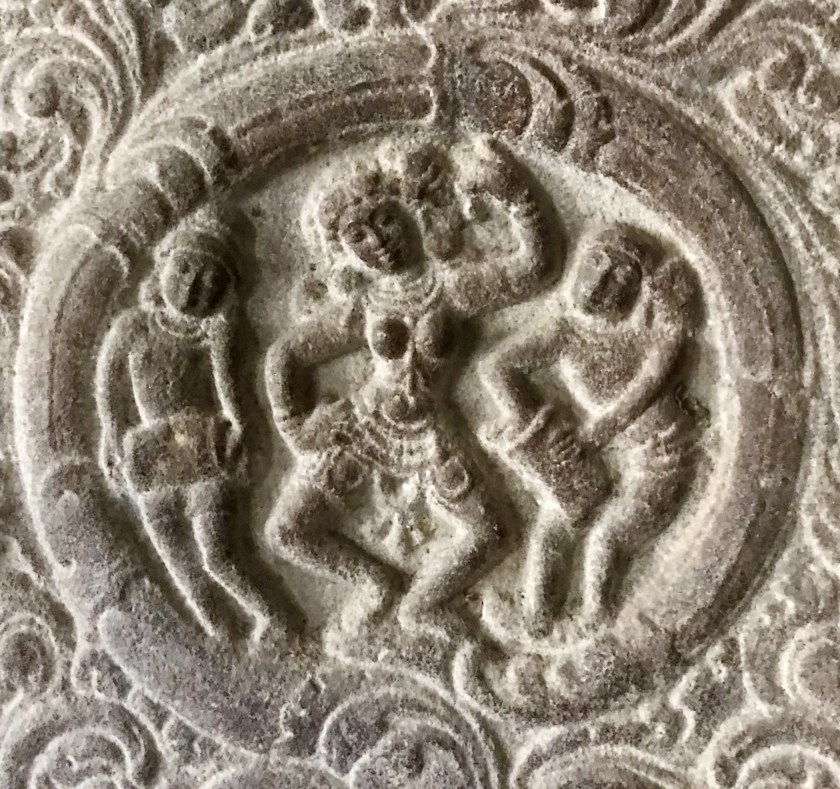
Dance as a commoner’s bread earning profession and accomplishment during the Sangam age, undergoes a huge transformation gradually through centuries. Predominantly associated with Gods and in praise of Gods during the Pallavas, Dance continued to be a vibrant part of temple arts during the Cholas as they passionately converted their temples into coliseums of performing arts, especially music and dance. The Chola temples that breathe art in the form of dance, music, sculptures, paintings and temple architecture till today, are display houses of their fervour for fine arts and architecture.

While dance during the Cholas is an inevitable part of any analysis on dance in Tamilnadu, the print version of Dr.R. Kalaikkovan’s doctoral thesis ‘Cholar kaala aadar kalai’, is inevitable in any analysis on dance during the Cholas. It is an amalgamation of facts, details and evidences based affirmatively on literature, inscriptions and sculptures covering almost 250 glorious years of chola art, from Vijayalaya to Adhirajendra (846 to 1070 CE).
This chapter is a student’s awe on dance during the cholas from Dr. Kalaikkovan’s book and thereby comprehension achieved from further reading and analysis.
To concisely understand the colossal achievement of Cholas, in enhancing the already elevated status of dance in Tamilagam and exceptionally institutionalising performing arts, dance during the Cholas in specific connection with Natya Sastra has been categorised here under these categories-
- Chokkam or Suththa Niruththam
- Adavallaan/ Natarajan
- Thalaikkol
- Thalicheri inscription of Rajaraja I
- Karana sculptures of Rajarajeshwaram
In all these topics, a glimpse of the trail left behind by rulers and authors prior to the Cholas in their inscriptions and works respectively is unavoidable. Apart from being serious evidences on the continuity of art forms in tamil land, the trail in terms of documentation of the past allows the researcher in me comprehend two things. One, the interesting and awe inspiring continuity of fine arts in Tamilagam and two, in contrast, the social changes it brought out through centuries. Hence, the essential details of the past, alongside the Chola triumphs in the field of arts will also be studied. Utmost care has been taken to avoid repetition from the previous two related posts, though.
- Chokkam

The commentaries on tamil works such as Tholkappiyam, Silappadhikaram and Yaapperungala Kaarikai name several texts on music and dance, but unfortunately those available today are three books on dance – namely Pancha Marabu and Kootha Nool in tamil and Natya Sastra in sanskrit. Scholars attribute the period of most of the commentators between 13th and 16th centuries CE. Since this falls after the triumphant years of the medieval Cholas, it is clear that the numerous texts mentioned by commentators were notably in use during the Chola period, construes Dr. R. Kalaikkovan in his book.
While explaining the different types of koothu learnt by Madhavi in aranketru kaathai of Silappadhikaram, commentator Adiyaarkku Nallaar talks in detail about santhi koothu. He says santhi koothu comprised of chokkam, meikoothu, avinayam and nadagam. He elicits further-
- Chokkam, also called suththa niruththam consisted of 108 karanas- combined actions of hands and legs;
- Meikoothu, dance with body movements consisted of desi, vaduku and singalam- based on love and deep emotions;
- Avinayam, not based on a story, denoted emoting according to the song; and
- Nadagam was koothu based on a story- a dance drama.
This is clear classification of dance and its variations as provided by Adiyaarkku Nallar, author during the Chola period. Now, Chokkam- the formative drill of dance curriculum was not new to the Cholas. There are several verses in Bhakti literature that provide evidences of chokkam to have been in continuous usage in Tamilnadu. The hymns of nayanmars stand proof of an already well-formatted system for dance education and performance in the tamil society for centuries.
In the verses of 7th century saiva saint Thirugnana Sambandhar, Shiva sings and dances the chokkam surrounded by ganas (சொக்கம தாடியும் பாடியும் -3.009.09). In another hymn, there is an interesting reminder of Ilangovadigal’s ‘darukan peruram kizhitha pen’ (verses 40-41, vazhakkurai kaathai, silappadhikaram). Here, Kali the previous leader of the glorious art performs chokkam. Shiva won over her and protected this earth (சொக்கத்தே நிருத்தத்தே தொடர்ந்தமங்கை -1.126.05).

Shiva, well versed in Chokkam was hence called ‘Chokkan’. Chokkan also denotes azhagan/ ‘beautiful person’. Or otherwise, the dance form introduced by chokkan- the most handsome of all could have been named ‘chokkam’. The verses of nayanmars seem to relate chokkan with dance. திருவாலவாய்ச் சொக்கனென்னுளிருக்கவே (3.039.11); பூதகணமாட ஆடும் சொக்கன்காண் (6.087.02); பொன்னம்பலத்தாடும் சொக்கனே (9.01.09); தில்லைச் சொக்கர் அம்பலவர் (9.04.08) are a few examples.
After the word ‘chokkam’ what about ‘karanam’? Sambandhar and Manikkavasagar use karanam as an act. Sambandhar talks of the act/karanam of Shiva pressing His toe to suppress Ravana (திருவிரலா லுதைகரணஞ் செய்துகந்த சிவமூர்த்தி -4.013.10). Manikkavasagar’s words of complete surrender, attribute activities/karanam of sensory organs to Shiva Himself (கூறும் நாவே முதலாகக் கூறுங் கரணம் எல்லாம்நீ -08.033.05). Appar and Sundarar precisely specify karanam related to dance. In Appar’s hymn, Shiva performs the karanas with His feet adorned with anklets as He dances to the tunes of several instruments played by bhootha ganas (கழலாடு திருவிரலாற் கரணஞ் செய்து -06.004.07). Sundarar clearly portrays the dancer Shiva performing karanas with dreadlocks flowing down (சடைகள் தாழக் கரண மிட்டு -07.06.03).
Traditional chokkam that constituted 108 karanas continued to be the formative system of chola dance education too. Chokkam of the Pallavas came to be known as suththa niruththam during the Cholas. Having understood chokkam or suththa niruththam, what about ‘Niruththam’? Appar and Sambandhar mention Shiva performing ‘Niruththam’; and Appar specifically talks of niruththam, performed by Shiva as per olden times (நிருத்தம் பழம்படி ஆடும் கழல் நம்மை ஆள்வனவே- 04.082.04). Dr. R. Kalaikkovan explains in his book- “As chokkam was called suththa niruththam, niruththam came to be known as avinayakoothu”. Avinayakoothu, is dance emoted according to the meaning of a song sung by a singer, and not on a story.
During the Cholas, dancers- men and women who were proficient in all four types of santhikoothu were called ‘santhikoothar’; those who were skilled in separate dance forms were called niruththa maaraayar, niruththa vidangi, nadaga maaraayar, avinayakoothar, agamaarka nattuvar and so on. Inscriptions of Viyakrapadhesuvarar temple, Vizhuppuram document the remuneration given to a niruththa vidangi for performing in front of the Lord during the temple festival.
The antiquity of dance in Tamilnadu, the acceptance of Bharata’s Natya Sastra as early as the Pallavas and the trail of chokkam in traditional tamil dance field getting formulated as the 108 karanas, are all strikingly visible through the karana sculptures that adorn their temple niches, pillars and walls alike.
2. Adavallaan

Karaikkal Ammaiyar, Thirunavukkarasar and Thirugnana Sambandhar’s portrayal of Shiva’s magnetic dance in words encouraged the Pallavas to create enthralling sculptures of the Lord of Dance. It is interesting to note the contributions of Sambandhar and Appar to the introduction of the word ‘Adavallaan’ (Sambandhar- ஆடவல்லஅடிகள் இடமாகும்.. நறையூரில் 1.029.04; Appar- விரதம் கொண்டு ஆடவல்லானும் 4.004.02; பாடவல்லார் பயின்று அந்தியும் சந்தியும் ஆடவல்லார் 4.017.07).
To illuminate the already elevated glory of Shiva’s proficiency in dance and music as Chokkan and Adavallaan, He is also revered as ‘koothan’ and ‘koothadavallaan’. Further, He is hailed by Thirumaligai Thevar as ‘ambalathu arasu’ (09.001.06) – King of the Dance Hall/field.
But, it seems the new power lords of South India post Pallavas, wanted a dynamic ‘full frame shot’ to capture the unmatched grace and eminence of the Lord of Dance. For this purpose, they chose the bhujangatrasitha karana. His signature shot, the bhujangatrasitha karana or the delightful Ananda Tandava pose can be seen in miniature sculptures of early chola temples, namely thudaiyur and thiruverumbiyur. In time, this falls prior to Chembian Madevi’s inimitable massive Adavallaan in stone and bronze in the temples she built and renovated.
As number of temples increased and the patronage of Kings grew wider during the Cholas, trust and devotion of the common man in religion and temples rose multifold. With extreme adoration for Shiva and His dance, the Cholas adorned the temples with stone and bronze sculptures of adavallan and deputed dancers and instrumentalists to perform in front of the Lord of Dance.
When the omnipresent Lord Himself is the greatest dancer, it is obvious that the society celebrates dance and its artists. Systematically, the Cholas converted their worship places into multi faceted cultural centres. Part of this major transition was the different Niruththa Mandapams or Dance Halls which were built to host several performances. These Niruththa Mandapams were also called sadhirsaalai, naadaga saalai and thiruvarangu. Karuvur Thevar states in his hymn on Rajarajesvaram that, elegant women learnt and performed dance in the naadaga saalai of thanjai rajarajeshvaram. (மின்நெடும் புருவத்து இளமயில் அனையர் /விளங்கல்செய் நாடகச் சாலை/ இன்நடம் பயிலும் இஞ்சிசூழ் தஞ்சை / இராசராசேச்சரத் திவர்க்கே- 9.16.8). Other halls such as thirukkaavanam and thiruvolakka mandapam were also used for dance purposes.
Chembian Madevi’s life size Adavallaan continued to be part of tamil temple architecture and her grandson Rajaraja I, the Great took much inspiration from her. Rajaraja’s fondness and intense admiration towards Adavallaan made him name even the measuring vessel for grains as ‘adavallaan marakkaal’.
The Cholas immortalised the glory of Dancing Shiva through their sculptural excellence, the reflection of which continues till today in all spaces and places. It is no wonder, to represent their unparalleled devotion for Shiva, Rajaraja I and son Rajendra I called themselves ‘Sivapadasekaran’ and ‘Sivacharanasekaran’ respectively.
3. Thalaikkol and other Honours

Chola inscriptions provide information in detail about artists and tutors. Those honoured with the title ‘Thalaikkoli’ served as dance tutors alongside nattuvars and koothar. Nattuvars were well versed in literature, music and drama. They taught dance to dancers of different thalicheris or residential dance schools. They were awarded the titles – niruththa peraiyan and niruththa maaraayan. Official orders on their appointments, responsibilities, remuneration are all clearly stated in inscriptions. Traditional dance forms such as santhi koothu, aariya koothu, thamizh koothu and kazhaai koothu were performed by Koothar on special occasions.
Silappadhikaram eulogises the presentation of Thalaikkol to the best dancer, when Madhavi receives it during her maiden performance. The one who was awarded the thalaikkol received the honour of ‘Thalaikkoli’. When dance became the performing arts of Gods and temples became learning centres, the honour of Thalaikkoli came with lot more responsibilities.
The Thalaikkol continued as the highest honour for a dancer and hence, the greatest dancer of the Pallava, Pandya and Chola eras – the Dancing Shiva possesses the thalaikkol in one of His hands in the bronze statue of Nallur.
The continuance of post sangam thalaikkol till the period of medieval cholas is proof to the standards and markers of ancient arts well preserved beyond several centuries and reigns. Udayarkudi Anandheeshvarar temple, Thiruvarur Thyagarajaswamy temple, Thiruvidaimarudhur, Thiruvaiyaru and Thiruvotriyur Adhipureeshvarar temple are few of the many temples, which record the names of thalaikolis in their inscriptions.
They performed dance in their respective temples and taught the art to thaliyilar and thevaradiyar. It is very important to note that the dancers, dance and music instructors, instrumentalists and koothars lived a respectful and economically stable life.
4. Thalicheri inscription of Rajaraja I

Along with their war winning streak, domination in inland and overseas trade, reverence to religion, construction of temples, glorifying arts and honouring artists, another aspect the Cholas excelled at was documenting details on all these through their exhaustive inscriptions. It is an undeniable fact that the available wealth of literature, sculptures and inscriptions in tamilnadu is the most voluminous in the whole of India. Among these, the Chola inscriptions present plenty of interesting insights, that would raise many an eyebrow.
Dr. R. Kalaikkovan’s extensive research on ‘Cholar kaala aadar kalai’ has literally left ‘no stone unturned’. The book decodes several of the distinct inscriptions of the chola period, that speak of the well established rules and regulations for artists and tutors of temple arts. These seem to have helped fine arts to flourish and most importantly safeguard livelihood of artisans.
One such inscription that is a gold mine of information on life, work and security of artists during Chola times is the 55.78 metre long, 73 line thalicheri inscription of Rajaraja I in Thanjavur Rajarajeshvaram. ‘Thali’ stands for temple and ‘cheri’ means residential area. The residential area of the temple dancers was called thalicheri.
Why is the thalicheri inscription considered till date a dossier on ‘Dance and life of Dancers during the Cholas’? There are endless research articles on this. A few points to refresh-
- there were thalicheris attached to several temples;
- the dancers of the thalicheris had transferrable jobs to other temples;
- 400 dancers were employed in Thanjavur temple alone who came from 102 thalicheris across the territory;
- they were accommodated in separate residences to learn and practice dance;
- 138 musicians, 7 nattuvars (dance teachers) and 4 paanar (music teachers) were assigned to tutor them
To know precisely about the impressive and unprecedented contractual policy stated in the thalicheri inscription, below is an excerpt from the article ‘Dance at its peak during Chola times’ (pg.380, Dr. R. Kalaikkovan and M. Subbulakshmi, published in the ‘Epic Saga of the Cholas’ – The Hindu Group)-
The distinguished feature of thalichcheri inscription is its contractual rules:
a) Upon demise or transfer of an artist, another qualified member of her family could join and perform.
b) If none qualified in the family, immediate relative could appoint a suitable artist for that place and probably share the income among them.
c) In a difficult situation of no eligible family or relative successor, colleagues of deceased artist holding similar position could find and appoint an appropriate person.
An interesting and unparalleled rule of decentralized administration, unique to the Cholas, clearly expounds concern on welfare of artists, including extended family.
Streamlined procedures of employment, remuneration, re-employment, smooth transfer of jobs, job security to dancers and family members were all kept on contract and well documented through inscriptions. These indeed convey the seriousness with which dance as a divine and dedicated art was respected during the Cholas.
Among the several fascinating facts about the thalicheri inscription is the documentation of names of all ‘thalicheri pendugal’ – the dancers of thalicheri and location of their houses in the area with the allotted house numbers. Further on, it is amazing to note the names of dancers related to dance and the supreme dancer. There were dancers with the name of Thillai, the foremost dance arena / the golden hall – Thillai Azhagi, Thillaikkaraisu and Thillaikkoothi; and with the names referring to dance- Ponnambalam, Ambalakkoothi, Arangam and the beautiful dancer Aadal Azhagi.
With the lift of His leg, He conquered Kali and became the Leader of the art and hence the names of two dancers are – Eduthapaadham and Seyyapaadham. There was yet another dancer by the name Kali, the Goddess who gracefully gave away Her place to Shiva. If Adavallaan was the greatest of all Dancers, the name of one thalicheri dancer was Adavallaal – the feminine version of Adavallaan.
The Dance that was presented by the God to the society, was to be performed before Him with all brilliance and humility as an act of gratitude. The Cholas seem to have created the thalicheris primarily for this purpose.
The concluding pages of Dr. R. Kalaikkovan’s ‘Cholar kaala aadar kalai’ provides a remarkable assertion. It talks about the respectful position of artists in society. They were presented with highly regarded titles and awards on special occasions, were an inclusive part of the social stratum, co-existed with other communities in the neighbourhood and excelled as generous donors to temples. It was during the later centuries of unstable reigns, that the lives of the artists which was dignified and disciplined during the cholas found a drastic decline.
5. Karana sculptures of Rajarajeshvaram

The Cholas celebrated Shiva the ecstatic dancer and his dance, and idolised the delightful Ananda Tandava pose as the striking shot of the millennium. The Supreme Dancer was also revered as the Supreme teacher- the teacher who taught karanas and angaharas to Thandu, who in turn taught Bharata the same on the instructions of Shiva. Documentation of Shiva as the dancer and Thandu, the student in sculpture, by Pallavas in ‘Athyanthakama Pallavesvaragruham’ in Mamallapuram near Chennai was previously discussed.
The term Cholas is synonymous with splendour. Magnificent temples; voluminous documentations; impressive sculptures- miniature to life size; radiant paintings; glorious performing arts; organised residential dance schools; flawless trade across the seas and many more to list. With specific focus on Natya Sastra and karana sculptures in Tamilnadu, Rajaraja I was the earliest to immortalise Bharata’s 108 karanas, in totality, in stone in the temples of Tamilagam. Rajaraja I, a trend setter in several fields, makes yet another first effort to present the 108 karanas as performed by the omnipotent mentor Himself (completed sculptures being 81). The significant perception and interpretation of Dance as a sacred art brought to the world by Shiva Himself reaches its zenith during the Cholas.
The place the great King chose for the remarkable project was the outer face of the inner wall of second floor of the Vimanam. The choice of place indicates the utmost respect and adoration Rajaraja I had for the art and the outstanding artist. It is a place of calm and tranquility above the presiding deity, and an uninterrupted area with no interfering sculptures. A thousand years ago in Rajaraja’s dream construction- one can imagine the bangs and clangs of the master sculptors alongside the elegant jingles of dancers with anklets, striking different poses, that must have resonated while creating the 108 karanas of thandavalakshana in sequence specified in Natya Sastra.
The similar exquisite place the great Emperor chose for the vibrant murals was the circumambulatory passage around the sanctum. Paintings of different scenes of the Bhakti movement that Rajaraja considered most exclusive adorn this passage. The panel that catches the eye and mind is that of Sundarar with special scenes from his life and travel to Kayilai with Cheraman Peruman. Above Sundarar’s huge elephant and Cheraman’s horse is the Court of Shiva where two gorgeous dancers perform to the beats of Kali and instrumentalists. As Sambandhar sings- ‘niruththar keethar idar kalaiyaai’ (நிருத்தர்கீதர் இடர்களையாய் நெடுங்களம் மேயவனே), Shiva is delighted with good music and all forms of dance and blesses the artists.
Sundarar’s panel catches the eye and mind, but one that captures the soul is the mural of Adavallaan – the finest dancer – unmatched teacher and artist in his dynamic pose and charming smile dancing blissfully as Ananda Tandavamurthy. In the panel, Rajaraja stands to the left of Adavallaan, with flowers in hand worshipping along with his three Queens. What more can Rajaraja ask for, than standing beside the Lord of Dance and watch His graceful moves?
Devotion with divine dance has been an integrated feature of Saivism in tamil society since the Pallavas. But, temples to Cholas meant taking religion and art to the apex of spiritual influence. Rajaraja’s master stroke of portraying Shiva as the Supreme Dancer in murals around the sanctum and Shiva as the artist/tutor performing the 108 karanas above the sanctum took this concept to unbelievably new heights. This undoubtedly symbolises the glorious era of dance and performing arts under the Cholas in Tamilnadu.
A formatted dance curriculum documented as early as post-sangam Silambu times, proceeding with refinement well further into the Pallava period and the pronounced influence and significance of dance during the Cholas as a quintessential part of temple art and performances can be visualised from Chola temples – their inscriptions, murals, sculptures and the dance halls that convey countless stories.
Writing ‘History of dance in tamil land’ in the first post and ‘Natya Sastra in the tamil spectrum’ in the second, has helped me in the comprehension and appreciation of the roots and growth of performing arts in Tamilnadu spread over a millennium. While post sangam Silappadhikaram showcased refinement in the well rooted performances, bhakti literature portrayed a different and defined flavour in its inclination towards religion. With this understanding, we moved on to Dance during the Cholas. It was a period that brought a new wave of captivating energy filled with aesthetic charm. They respected the artists, aimed at academic enrichment and above all, harmonised the art into an organised structure.
From the days of Tolkappiyam before common era till the first few centuries of the second millennium, it had been a long journey for Dance in the land of the Tamils. Thanks to the documentation of authors, rulers, and sculptors; and the commentators, scholars and epigraphists; tracking the extensive path has been made uncomplicated and accomplishable for researchers.
Research Guidance Courtesy: Dr M. Rajamanikkanar Centre For Historical Research, Thiruchirappalli.
References –
- இரா. கலைக்கோவன், சோழர் கால ஆடற்கலை
- இரா. கலைக்கோவன், புள்ளமங்கை ஆலந்துறையார் கோயில்
- சிலப்பதிகாரம்- மூலமும் அரும்பத உரையும் அடியார்க்கு நல்லார் உரையும், உ.வே.சா. பதிப்பு
- Manomohan Ghosh, The NatyaSastra
- Adya Rangacharya, Introduction of Bharata’s Natya Sastra
- Dr.R.Kalaikkovan and Dr.M.Nalini, சோழர் கால ஆடலாசான்கள், varalaaru.com
- அர. அகிலா, இரா. கலைக்கோவன், ஒரு நாடகக் காணி கல்வெட்டான வரலாறு, varalaaru.com
- Dr. R. Kalaikkovan and M. Subbulakshmi, Dance at its peak during chola times, Epic Saga of the Cholas, The Hindu Group
- Thirugnana Sambandhar Thevaram, thevaaram.org
- Thirunavukkarasar Thevaram, thevaaram.org
- Sundarar Thevaram, thevaaram.org
- Manikkavasagar, 8th Thirumurai, thevaaram.org
- Thirumaaligai Thevar, 9th Thirumurai, thevaaram.org
- Karuvur Thevar, Thanjai Rajarajesvaram, 9th Thirumurai, thevaaram.org
- Thalicheri inscription of Rajaraja I, South Indian inscriptions and Tamil inscriptions of Rajaraja, Rajendra – Chola and others in the Rajarajesvara Temple At Tanjavur volume II-Part III, archives.org
- P.S. Sriraman, Chola Murals
 glorioustamils